-min.png "kartikheater")
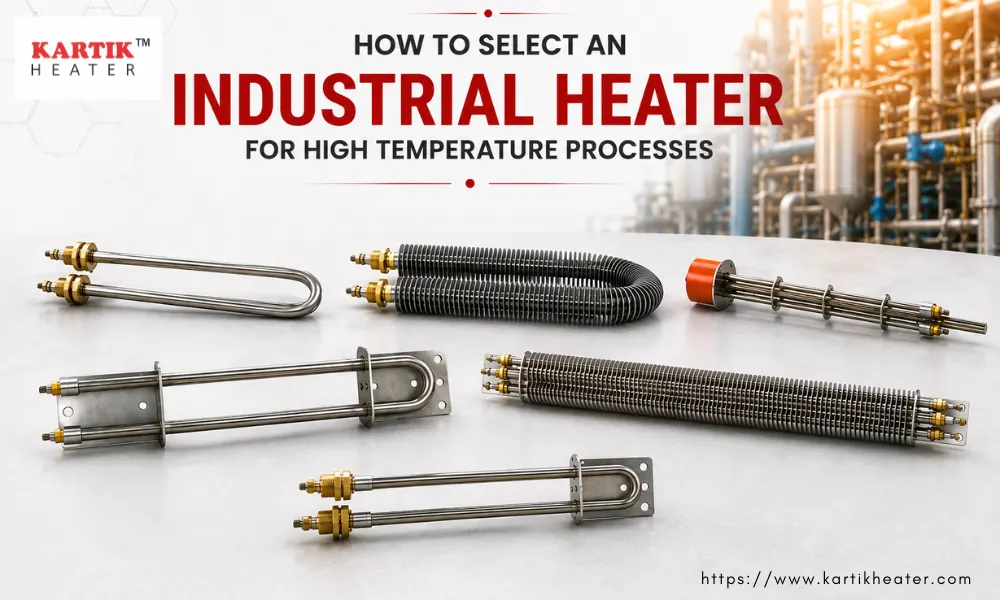
Industrial manufacturing processes operating at elevated temperatures require heating solutions that deliver consistent performance, energy efficiency, and long-term reliability. Whether the application involves drying, curing, heating process air, maintaining liquid temperatures, or transferring heat to machinery, selecting the right high temperature industrial heaters directly influences production quality, operational efficiency, and equipment life.
For industries across Vapi, Valsad, Sarigam, Pardi, Udvada, Umargam, Daman, Silvassa, and throughout India, selecting the appropriate industrial electric heater involves evaluating process temperature, heating medium, airflow requirements, sheath material, watt density, and installation conditions. Working with an experienced industrial heater manufacturer India, such as Kartik Heater, can simplify this selection process by providing application-specific heating solutions.
What Are High-Temperature Industrial Heaters?
High temperature industrial heaters are electric heating devices engineered to generate and maintain elevated temperatures for demanding industrial applications. They convert electrical energy into heat through resistance heating and are designed to withstand continuous operation in challenging manufacturing environments.
Depending on the application, these heaters can transfer heat to:
-
Air
-
Liquids
-
Oils
-
Chemicals
-
Metal surfaces
-
Production machinery
-
Drying chambers
-
Industrial process equipment
Among the most versatile heating technologies is the industrial tubular heater. It consists of a resistance wire embedded within high-purity magnesium oxide (MgO) insulation and enclosed inside a metallic sheath. This construction provides excellent electrical insulation while enabling efficient heat transfer.
An industrial air heater is commonly manufactured by arranging multiple tubular heating elements inside a duct, chamber, or air-handling system. As air flows across these heated tubular elements, it absorbs heat before being distributed throughout the process. This is why tubular heaters form the foundation of many industrial air heating systems.
Because of their flexibility, durability, and customization options, tubular heaters are widely used as the primary high temperature heating element in modern industrial heating systems.
Key Features and Benefits of High Temperature Industrial Heaters
Choosing the right industrial process heater provides benefits that extend well beyond simply generating heat.
Reliable High-Temperature Performance
Industrial heaters are designed to maintain stable operating temperatures over extended production cycles, supporting processes that demand continuous and controlled heating.
Efficient Heat Transfer
The compact design of a tubular heater allows heat to transfer efficiently to air, liquids, or metal surfaces, reducing energy losses and improving overall process efficiency.
Excellent Mechanical Strength
Industrial environments expose heating equipment to vibration, temperature cycling, moisture, and contaminants. High-quality tubular heating elements are designed to withstand these demanding conditions.
Flexible Design
Tubular heaters can be manufactured in straight, U-shaped, W-shaped, circular, or custom bent configurations to match specific machinery and installation requirements.
When incorporated into an industrial air heater, multiple tubular elements can be arranged to provide uniform airflow heating across ducts, ovens, dryers, and process chambers.
Accurate Temperature Control
When integrated with suitable temperature controllers and sensors, industrial heaters help maintain stable process temperatures, reducing production variation and improving product consistency.
Energy Efficiency
Properly designed industrial heating systems deliver heat where it is required, minimizing unnecessary energy consumption while supporting efficient manufacturing operations.
How High Temperature Industrial Heaters Improve Industrial Performance
Industrial heating equipment directly affects production quality, operating costs, and equipment reliability.
Improved Process Stability
Consistent temperatures reduce fluctuations that may otherwise affect product quality, drying rates, curing times, or chemical reactions.
Higher Product Quality
Uniform heat distribution minimizes overheating, underheating, and uneven processing, leading to more consistent production outcomes.
Reduced Equipment Downtime
Selecting the appropriate process heating equipment reduces the likelihood of premature heater failure and unexpected production interruptions.
Lower Maintenance Requirements
Choosing the correct heater design and sheath material for the application helps reduce corrosion, scaling, and mechanical wear.
Better Energy Utilization
An appropriately sized industrial electric heater reaches target temperatures efficiently without excessive power consumption.
Applications Across Industries
Because tubular heating technology can be adapted for various heating methods, high temperature industrial heaters are used across numerous industries.
Chemical Processing
Industrial heaters maintain process temperatures in tanks, reactors, pipelines, and chemical vessels where precise thermal control is essential.
Food Processing
Industrial air heaters built with tubular heating elements are widely used for drying, baking, roasting, dehydration, and food processing applications requiring uniform hot air circulation.
Pharmaceutical Manufacturing
Controlled heating supports sterilization, drying, formulation, and clean manufacturing processes where temperature consistency is critical.
Plastic and Polymer Processing
Extrusion machines, moulding equipment, thermoforming systems, and polymer processing units rely on tubular heating elements to maintain accurate processing temperatures.
Packaging Industry
Tubular heaters are commonly integrated into sealing machines, shrink tunnels, hot air systems, and packaging equipment requiring reliable heat generation.
Textile Manufacturing
Air heaters help dry fabrics, cure coatings, and maintain controlled temperatures during textile production.
Paint and Powder Coating
Industrial air heating systems provide the hot air required for curing painted and coated components while maintaining uniform temperature distribution.
Metal Processing
Heat treatment, drying, preheating, and finishing operations depend on durable industrial heating equipment capable of operating under demanding conditions.
HVAC and Air Handling Systems
Electric air heaters are widely installed in industrial ventilation systems, air handling units, and process air equipment where heated airflow is required.
Key Factors to Consider When Selecting an Industrial Heater
Selecting the right high temperature industrial heaters requires more than choosing the highest temperature rating or wattage. Every industrial process has unique heating requirements, and the heater should be selected based on process conditions, operating environment, and long-term performance expectations. Considering these factors during the specification stage helps improve efficiency, reduce maintenance, and extend equipment life.
Define the Process Heating Requirement
Start by understanding what needs to be heated and why. An industrial heater used for heating process air will have different design requirements than one used for heating liquids or metal surfaces.
Consider the following:
-
Heating medium (air, liquid, oil, chemical, or metal)
-
Target operating temperature
-
Maximum temperature requirement
-
Continuous or intermittent operation
-
Required heat-up time
-
Process stability requirements
A clear understanding of these parameters helps determine the most suitable industrial process heater configuration.
Calculate the Required Heat Load
The heater should be sized according to the amount of heat energy needed by the process. Undersized heaters may struggle to reach the desired temperature, while oversized heaters can consume unnecessary energy and reduce temperature control accuracy.
Heat load calculations typically consider:
-
Mass or airflow
-
Initial and target temperatures
-
Heating time
-
Heat losses to the environment
-
System efficiency
Accurate heat load calculations contribute to better energy efficiency and improved process performance.
Consider Watt Density
Watt density refers to the amount of power generated per unit surface area of the heating element. It is one of the most important factors affecting heater life and performance.
Selecting the appropriate watt density helps:
-
Prevent overheating of the sheath
-
Protect temperature-sensitive materials
-
Improve heater lifespan
-
Reduce scaling and carbonization
-
Maintain consistent heat transfer
Higher watt density is not always better. The appropriate value depends on the heating medium and operating conditions.
Evaluate Airflow Requirements
When selecting an industrial air heater, airflow becomes a critical design parameter because the tubular heating elements rely on moving air for effective heat transfer.
Important considerations include:
-
Air velocity
-
Air volume
-
Air pressure
-
Temperature rise (ΔT)
-
Duct dimensions
-
Air distribution uniformity
Insufficient airflow may increase the sheath temperature of the tubular elements, reducing service life and affecting performance.
Process Temperature vs Sheath Temperature
Many engineers focus only on the required process temperature, but the sheath temperature of the heating element is equally important.
For example, a process requiring 250°C air temperature may expose the heater sheath to considerably higher temperatures depending on airflow and watt density.
Maintaining acceptable sheath temperatures improves durability and helps prevent premature heater failure.
Installation Environment
Industrial heaters operate in a wide variety of environments. Installation conditions influence material selection and heater design.
Evaluate:
-
Moisture exposure
-
Dust levels
-
Corrosive chemicals
-
Outdoor or indoor installation
-
Mechanical vibration
-
Ambient temperature
Selecting the appropriate enclosure, terminal arrangement, and sheath material helps ensure reliable long-term operation.
Standard Tubular Heater vs Tubular Air Heater Assembly
Although these products are often discussed separately, it is important to understand that an industrial air heater is typically an engineered assembly that uses tubular heating elements as its primary heat source.
The selection is therefore not about choosing one technology over another. Instead, it involves selecting the appropriate configuration based on how heat is transferred within the process.
Standard Tubular Heater
A standard tubular heater transfers heat directly to liquids, solids, machinery, or metal surfaces. It can also be installed inside tanks, moulds, dies, process vessels, and industrial equipment.
Typical applications include:
-
Chemical tanks
-
Oil heating
-
Water heating
-
Packaging machinery
-
Plastic processing
-
Food equipment
-
Pharmaceutical machinery
-
Industrial ovens
-
Metal processing equipment
Because tubular heaters can be bent into numerous shapes, they are highly adaptable to different machine designs and process requirements.
Tubular Air Heater Assembly
An industrial air heater consists of multiple tubular heating elements arranged within a frame, duct, chamber, or housing through which air flows.
Instead of heating a solid or liquid directly, the tubular elements transfer heat to moving air. The heated air is then circulated throughout the process.
This configuration is commonly used in:
-
Drying ovens
-
Air handling units
-
Textile dryers
-
Powder coating systems
-
Paint curing ovens
-
Packaging tunnels
-
Food drying equipment
-
HVAC process heating
-
Industrial drying chambers
The choice depends primarily on whether the process requires direct surface heating or controlled heated airflow.
Materials and Design Features for High-Temperature Applications
Material selection plays a significant role in the performance and longevity of industrial heating equipment.
Heating Element Construction
Most industrial tubular heaters use resistance wire positioned centrally inside a metallic sheath and surrounded by compacted magnesium oxide insulation.
This construction offers:
-
Efficient heat transfer
-
High electrical insulation
-
Excellent mechanical strength
-
Reliable performance under continuous operation
Sheath Materials
Different industrial environments require different sheath materials.
Common options include:
-
Stainless Steel 304
-
Stainless Steel 310
-
Stainless Steel 321
-
Incoloy 800
The appropriate material depends on operating temperature, corrosion potential, and process media.
Magnesium Oxide Insulation
High-purity MgO provides:
-
Excellent dielectric strength
-
Efficient thermal conductivity
-
Stable performance at elevated temperatures
-
Long service life
Custom Manufacturing
Many industrial processes require heaters with customized:
-
Voltage ratings
-
Wattage
-
Length
-
Diameter
-
Heated sections
-
Cold ends
-
Mounting arrangements
-
Terminal configurations
-
Flange designs
Custom-engineered heaters often integrate more efficiently into existing production systems than standard products.
Common Mistakes to Avoid
Selecting high temperature industrial heaters without considering application requirements can reduce equipment performance and increase operating costs.
Common mistakes include:
-
Selecting a heater based only on price
-
Ignoring heat load calculations
-
Choosing incorrect watt density
-
Overlooking airflow requirements in air heating applications
-
Selecting unsuitable sheath materials
-
Underestimating environmental conditions
-
Using standard heaters where custom designs are more appropriate
-
Not consulting an experienced industrial heater manufacturer India
Avoiding these mistakes helps improve heater reliability and overall production efficiency.
Choosing a Reliable Industrial Heater Manufacturer in India
The performance of high temperature industrial heaters depends not only on their design but also on the engineering expertise and manufacturing standards of the supplier. Whether you require a standalone industrial tubular heater, a custom industrial air heater, or a complete industrial heating system, selecting the right manufacturing partner is essential for long-term process reliability.
When evaluating an industrial heater manufacturer India, consider the following factors.
Application Engineering Expertise
Every industrial process has unique heating requirements. An experienced manufacturer evaluates operating temperature, heating medium, airflow, installation conditions, and production objectives before recommending a solution.
Rather than supplying a standard product for every application, the manufacturer should be capable of recommending the most suitable heater configuration for your process.
Product Quality and Material Selection
The durability of an industrial electric heater largely depends on the quality of its components. Reliable manufacturers use suitable sheath materials, high-quality resistance wire, and properly compacted magnesium oxide insulation to achieve efficient heat transfer and dependable electrical insulation.
Material selection should always match the operating environment, especially when heaters are exposed to moisture, chemicals, high temperatures, or corrosive media.
Custom Manufacturing Capabilities
Industrial equipment rarely follows a single standard design. A capable tubular heater manufacturer India should be able to manufacture heaters according to application-specific requirements, including:
-
Heater diameter
-
Voltage
-
Wattage
-
Heated length
-
Bending configuration
-
Terminal design
-
Flange mounting
-
Electrical connections
Customization improves installation compatibility and helps achieve better thermal performance.
Manufacturing Consistency
Consistency is critical when multiple heaters are installed in the same production line. Uniform manufacturing processes help ensure that heaters deliver predictable performance across batches, reducing maintenance issues and supporting stable production.
Technical Support
Selecting the correct heater often requires engineering guidance. Manufacturers who provide technical assistance during product selection, installation, and replacement help customers reduce specification errors and improve operational reliability.
Reliable Supply
Timely delivery is important for planned maintenance, equipment upgrades, and new industrial projects. Working with an established industrial heater manufacturer India helps maintain continuity in production and spare part availability.
For industries located in Vapi, Valsad, Udvada, Pardi, Sarigam, Umargam, Daman, Silvassa, and across India, partnering with a manufacturer that combines engineering expertise with custom manufacturing capabilities can simplify the selection of reliable process heating equipment.
Why Industries Prefer High Temperature Industrial Heaters
Modern manufacturing facilities continue to invest in high temperature industrial heaters because they support efficient, reliable, and controlled production processes.
Industries prefer these heating solutions because they offer:
-
Consistent heat distribution
-
High thermal efficiency
-
Compatibility with continuous production
-
Accurate temperature control
-
Long operational life
-
Flexible installation options
-
Custom manufacturing possibilities
-
Reduced maintenance requirements
-
Integration with automated industrial systems
Whether the application involves process air heating, liquid heating, drying, curing, or equipment heating, properly engineered industrial heating systems contribute to stable production and improved operational efficiency.
Why Choose Kartik Heater?
Selecting the right manufacturing partner is just as important as selecting the right heater.
Kartik Heater manufactures industrial heating solutions designed to meet diverse process heating requirements across multiple industries. With experience in designing and manufacturing tubular heaters and industrial air heaters, the company supports applications requiring reliable and efficient high-temperature heating.
Kartik Heater focuses on:
-
Manufacturing quality industrial heating equipment
-
Custom-designed industrial tubular heater solutions
-
Industrial air heaters built using precision-engineered tubular heating elements
-
Application-based engineering support
-
Consistent manufacturing quality
-
Reliable product supply
-
Customer-focused technical assistance
-
Solutions tailored to specific industrial processes
Serving customers across Vapi, Valsad, Sarigam, Udvada, Pardi, Umargam, Daman, Silvassa, Gujarat, and throughout India, Kartik Heater works with manufacturers seeking dependable heating solutions for demanding industrial applications.Contact Kartik Heater now.
Conclusion
Selecting the right high temperature industrial heaters begins with understanding your process rather than simply choosing a heater with the highest temperature rating. Factors such as the heating medium, required operating temperature, watt density, airflow, sheath material, installation environment, and heat load all influence the performance and lifespan of an industrial heating system.
By partnering with an experienced industrial heater manufacturer India, businesses can benefit from application-specific engineering, quality manufacturing, and customized solutions that support efficient and reliable production. Whether your facility is located in Vapi, Valsad, Udvada, Pardi, Sarigam, Umargam, Daman, Silvassa, or anywhere else in India, Kartik Heater offers industrial heating solutions designed to meet the performance requirements of modern manufacturing operations.