-min.png "kartikheater")
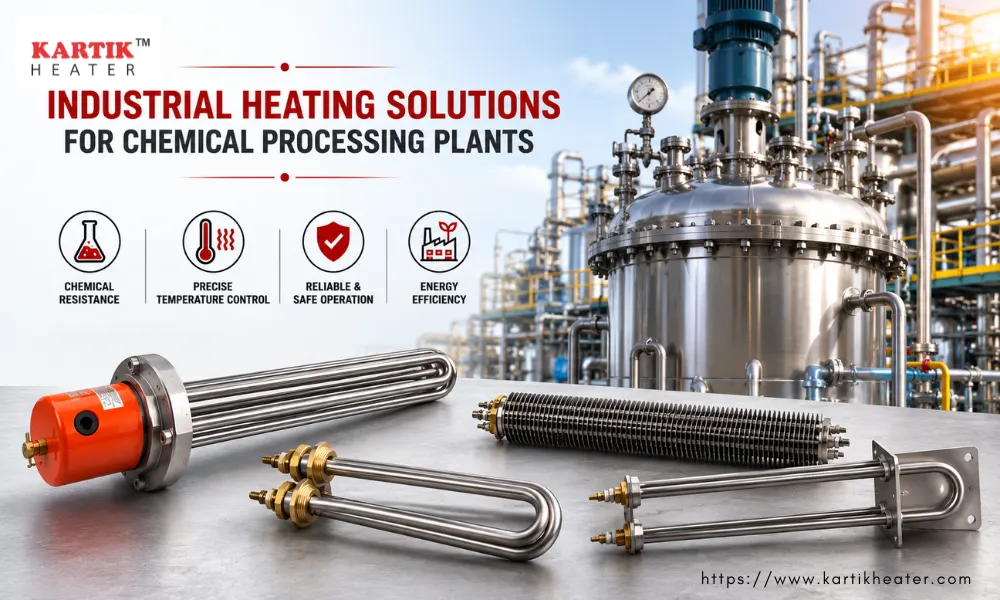
Chemical processing plants require controlled and reliable heating for applications such as chemical tank heating, solution preparation, viscosity control, evaporation, cleaning, and other process operations. Selecting suitable industrial heaters for chemical industry applications is therefore not simply a matter of choosing the required power rating. Heater material, watt density, immersion length, operating temperature, chemical compatibility, and installation method can all affect performance and service life.
Two commonly used solutions are the tubular heating element and industrial immersion heater. Tubular heaters can be configured for direct or indirect heating applications, while immersion heaters transfer heat directly into liquids contained in process tanks, vessels, or circulation systems.
For chemical manufacturers in Vapi, Sarigam, Pardi, Valsad, Umargam, Udvada, Daman, and Silvassa, application-specific heating equipment can help maintain consistent process conditions while reducing avoidable heating-related downtime.
What Are Industrial Heaters for Chemical Industry?
Industrial heaters for chemical industry applications are electrically powered heating systems designed to provide controlled heat to chemical solutions, process fluids, tanks, vessels, air, or other process media.
The appropriate heater depends on the application. For example, an immersion heater for chemical tanks is placed directly into the liquid, whereas a tubular heater for chemical processing can be incorporated into equipment where direct or indirect heat transfer is required.
The main objective is controlled and uniform heat delivery without compromising the heater material or contaminating the process medium.
Why Heating Requires Careful Design in Chemical Processing
Chemical plants can expose heating equipment to corrosive liquids, high temperatures, demanding operating cycles, and variable fluid properties. A heater that works effectively in water may not be suitable for an aggressive chemical solution.
Important design parameters include:
-
Chemical composition and concentration
-
Required operating temperature
-
Tank dimensions and liquid level
-
Required heating capacity
-
Immersion length
-
Watt density
-
Available electrical supply
-
Heater mounting arrangement
-
Material compatibility
-
Required temperature control
This is why a standard heater should not automatically be treated as the best solution for every chemical process.
Key Features of Chemical Process Heating Solutions
Material Compatibility
Material selection is one of the most important considerations. Depending on the chemical environment, stainless steel or other suitable sheath materials may be required.
An SS316 heating element, for example, can be considered where its corrosion resistance characteristics are appropriate for the process. However, material selection should always be based on the actual chemical composition, concentration, temperature, and exposure conditions rather than the material name alone.
Controlled Watt Density
Watt density refers to the electrical power generated over the heating surface area. Excessive watt density can cause high surface temperatures and may be unsuitable for certain fluids.
Selecting an appropriate watt density can help improve heat transfer while reducing the risk of localized overheating or fluid degradation.
Correct Immersion Length
The immersion length must correspond to the operating liquid level and tank geometry. An incorrectly selected length can result in ineffective heating or exposure of an active heating section outside the liquid.
Temperature Control
Accurate temperature control is essential in chemical processing. Thermostats, temperature sensors, controllers, and suitable control panels can be incorporated into the heating system depending on process requirements.
Stable temperature control helps maintain repeatable process conditions and can reduce unnecessary energy consumption.
Custom Configuration
A custom heating element may be appropriate when standard dimensions, power ratings, mounting arrangements, or electrical connections do not match the process equipment.
Custom designs can account for tank geometry, available installation space, heating zones, immersion depth, and process requirements.
Applications of Industrial Heaters in Chemical Processing
Chemical Tank Heating
An industrial immersion heater is commonly used for heating liquids directly inside tanks. Applications may include maintaining process temperature, warming solutions before processing, and preventing excessive viscosity changes.
A flange-mounted heater can be suitable where the tank design requires a secure and serviceable heater connection.
Process Fluid Heating
Industrial heaters can maintain the temperature of process fluids before they enter subsequent production stages. Consistent heating can help maintain predictable fluid properties and process conditions.
Cleaning and Washing Solutions
Some industrial cleaning systems require heated solutions to achieve the desired operating conditions. Immersion heating can provide direct heat transfer within tanks or vessels.
Temperature Maintenance
Not every application requires rapid heating. In some processes, the main requirement is maintaining a fluid within a defined temperature range. Properly sized heaters and controls can provide controlled heat input for such applications.
Chemical Storage
Storage tank heating may be required when a stored liquid becomes too viscous at lower temperatures or requires temperature maintenance for downstream processing.
How Proper Heater Selection Improves Industrial Performance
A correctly engineered heating system can improve chemical processing performance in several ways:
-
More consistent process temperatures
-
Better heat transfer efficiency
-
Reduced risk of localized overheating
-
Improved process repeatability
-
Appropriate compatibility with process chemicals
-
Easier maintenance and replacement
-
Better control of energy consumption
-
Reduced heating-related production interruptions
For example, a properly selected immersion heater can distribute heat throughout a process tank more effectively when the heater location, watt density, fluid circulation, and control strategy are considered together.
Factors to Consider Before Selecting a Heater
Before purchasing an industrial heater for chemical processing, engineers and procurement teams should evaluate:
1. Chemical Compatibility
Identify the exact chemical, concentration, additives, and operating conditions. Do not select a heater material based only on the general category of the liquid.
2. Operating Temperature
Define normal, minimum, and maximum operating temperature requirements. The heater and associated controls should be suitable for the intended temperature range.
3. Heating Capacity
Calculate the required heat load based on fluid quantity, starting temperature, target temperature, heating time, heat losses, and process conditions.
4. Watt Density
Select an appropriate watt density based on the characteristics of the fluid and required heat transfer conditions.
5. Installation Method
Determine whether the process requires a flange-mounted, threaded, or another suitable configuration.
6. Tank Geometry
Tank depth, liquid level, circulation pattern, and available mounting space influence heater dimensions and immersion length.
7. Applicable Standards
Where required by the project, plant, or regulatory framework, heater design and installation should be evaluated against applicable IS standards, electrical requirements, safety practices, and site specifications. The applicable standard should be confirmed for the specific equipment and application rather than assumed.
Common Mistakes to Avoid
Chemical plants should avoid selecting heaters solely on initial purchase price. Common mistakes include:
-
Choosing an unsuitable sheath material
-
Ignoring chemical concentration
-
Using excessive watt density
-
Incorrectly specifying immersion length
-
Underestimating heat losses
-
Installing a heater without adequate temperature control
-
Selecting a standard heater when a custom configuration is necessary
-
Failing to consider maintenance access
The lowest-cost heater is not necessarily the lowest-cost solution over its operating life. Material compatibility, reliability, energy use, maintenance, and process stability should all be considered during procurement.
Why Industries Prefer Industrial Heaters for Chemical Industry
Chemical processing plants need heating equipment that can operate consistently under demanding process conditions. The preference for application-specific industrial heaters for chemical industry applications comes from the need to balance heating capacity, temperature control, material compatibility, maintenance, and operational reliability.
An appropriately selected industrial immersion heater can provide direct heating for process tanks, while a tubular heating element can be configured for different industrial heating requirements. The right solution depends on the fluid being heated, tank design, required temperature, and operating conditions.
Industries generally prioritize heating systems that provide:
-
Consistent and controllable heat output
-
Suitable material compatibility
-
Appropriate watt density
-
Reliable temperature control
-
Practical installation and maintenance
-
Custom configurations where required
-
Efficient heat transfer
-
Compatibility with existing process equipment
For chemical manufacturers, the objective should not simply be maximum heating power. A properly engineered system should deliver the required heat without creating unnecessary thermal stress or compromising the process fluid.
Choosing Between Tubular and Immersion Heaters
The choice between a tubular heater and an immersion heater depends primarily on how heat needs to be transferred.
An immersion heater for chemical tanks is suitable when direct heating of a liquid is required. It is installed within the tank or vessel and transfers heat directly into the process medium.
A tubular heater for chemical processing can be configured for applications where the heating element needs to be integrated into equipment, ducts, chambers, or other process systems.
Before selecting either option, consider:
-
Type and properties of the process medium
-
Required heating capacity
-
Operating temperature
-
Tank or equipment configuration
-
Available installation space
-
Material compatibility
-
Required temperature uniformity
-
Maintenance requirements
For specialized applications, Kartik Heater can evaluate the process requirements and determine whether a standard or custom heating element is more appropriate.
Applications Across Chemical Processing Industries
Industrial heating systems can support a broad range of chemical manufacturing and processing operations.
Chemical Manufacturing
Heating can be required for controlled reactions, solution preparation, fluid conditioning, and temperature maintenance.
Pharmaceutical and Specialty Chemical Processing
Controlled heating can support processes where stable temperatures and repeatable operating conditions are important.
Petrochemical and Oil-Based Processing
Heating systems can be used for fluid conditioning, viscosity management, and controlled heating of oils and process liquids.
Water and Wastewater Treatment
Immersion heating can be used in selected treatment processes where maintaining a specific liquid temperature is required.
Industrial Coatings and Resins
Certain coating, resin, and formulation processes require controlled heating to maintain appropriate viscosity and processing characteristics.
These applications demonstrate why industrial heating solutions for chemical plants need to be selected according to the actual process rather than using a single heater configuration across different applications.
Why Choose Kartik Industrial Heater Pvt. Ltd.?
Kartik Industrial Heater Pvt. Ltd., also known as Kartik Heater, manufactures industrial heating solutions for applications requiring controlled and dependable heat transfer.
The company focuses on understanding the operating requirements before determining the appropriate heater configuration. For chemical applications, this can include evaluating heater dimensions, power requirements, mounting arrangement, material selection, immersion length, and operating conditions.
Kartik Heater provides:
-
Experience in industrial heater manufacturing
-
Tubular and immersion heating solutions
-
Custom manufacturing capabilities
-
Application-focused heater configurations
-
Technical assistance during product selection
-
Quality-focused manufacturing processes
-
Reliable supply for industrial requirements
-
Consistent product specifications
-
Customer-focused technical support
For chemical plants, the ability to specify a heater according to the actual process can be particularly important where standard heating equipment does not adequately match the application.
Manufacturers and process industries in Vapi, Sarigam, Pardi, Valsad, Umargam, Udvada, Daman, and Silvassa can source application-specific industrial heating solutions from a manufacturer located in the wider industrial region of Gujarat.
Industrial Heating Solutions for Chemical Plants in Gujarat and India
Gujarat has a significant concentration of chemical and process manufacturing activity. Industrial areas around Vapi, Sarigam, Pardi, Valsad, and Umargam, along with nearby industrial regions of Daman and Silvassa, have diverse requirements for process heating equipment.
For these facilities, working with an industrial heater manufacturer in India can simplify communication around heater specifications, customization, technical requirements, and supply.
Kartik Heater serves industrial customers requiring tubular and immersion heating solutions for process applications. Instead of treating every chemical heating requirement as identical, heater selection can be based on the specific process conditions and equipment configuration.
Conclusion
Selecting industrial heaters for chemical industry applications requires more than choosing a heater based on wattage. Chemical compatibility, temperature control, watt density, immersion length, heat transfer efficiency, mounting arrangement, and operating temperature all influence the suitability of a heating system.
An industrial immersion heater is commonly suited to direct heating of liquids in tanks and vessels, while a tubular heating element can be adapted to various process heating configurations. In applications involving aggressive chemicals, material compatibility must be evaluated carefully before selecting a corrosion-resistant heater or an SS316 heating element.
Kartik Industrial Heater Pvt. Ltd. offers tubular and immersion heaters for industrial and chemical process heating. Serving manufacturers across Vapi, Valsad, Sarigam, Pardi, Umargam, Udvada, Daman, Silvassa, and India, we provide application-specific heating solutions for reliable, consistent performance. Contact Kartik Heater today to find the right heater for your process.