-min.png "kartikheater")
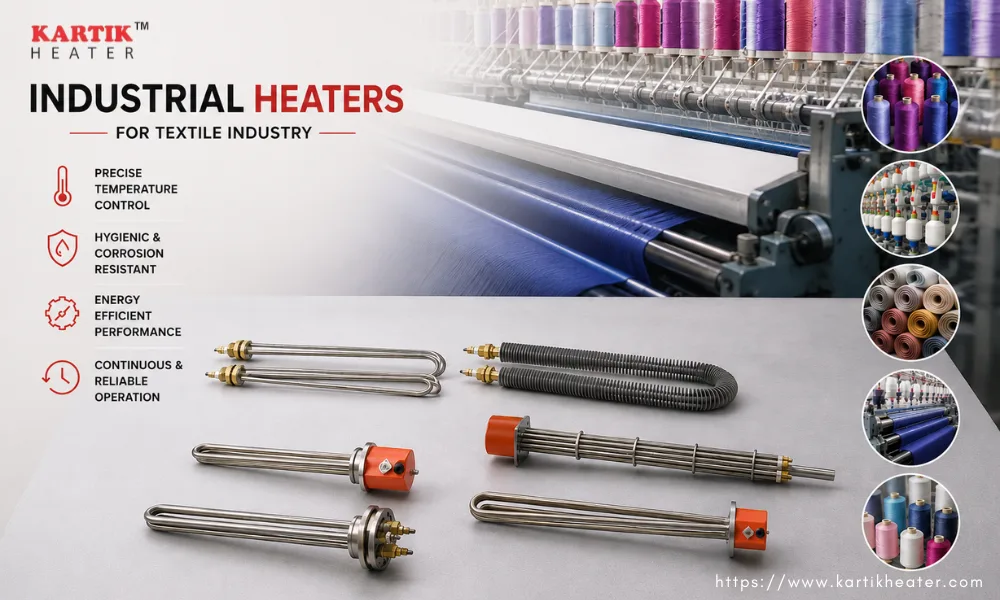
The textile manufacturing industry depends on precise and reliable heating throughout every stage of production. Processes such as dyeing, drying, printing, finishing, coating, heat setting, and moisture control all require carefully maintained temperatures to achieve consistent fabric quality and production efficiency. Selecting the right industrial heaters for textile industry applications helps manufacturers improve product quality, reduce energy consumption, and minimize production downtime.
Among the most widely used heating solutions are the industrial air heater and tubular heater. An industrial air heater provides controlled hot airflow for drying and heat-setting operations, while a tubular heater delivers efficient conductive heating for machinery, tanks, molds, and specialized textile processing equipment.
As textile manufacturers continue to modernize their production facilities, reliable industrial heating systems have become essential for maintaining continuous operations and meeting quality standards. Properly designed heating solutions support better temperature control, improved productivity, and long-term equipment performance.
What Are Industrial Heaters for the Textile Industry?
Industrial heaters for textile industry applications are heating devices designed to generate controlled thermal energy for various textile manufacturing processes. These heaters are integrated into textile processing equipment to maintain precise operating temperatures during production.
Two commonly used heating solutions include:
-
Industrial air heaters, which provide heated airflow for drying, curing, and heat-setting applications.
-
Industrial tubular heaters, which supply direct heating to machinery, tanks, rollers, and process equipment.
Both heater types play an important role in improving production consistency while supporting efficient textile manufacturing.
Heating Requirements in Textile Manufacturing Plants
Textile production involves multiple processes that require different temperature ranges. Maintaining accurate temperatures helps ensure consistent dye absorption, fabric finishing, drying performance, and product quality.
Important heating requirements include:
Uniform Temperature Distribution
Consistent heat distribution helps prevent uneven drying, colour variation, and defects in finished fabrics.
Continuous Production
Most textile plants operate continuously. Heating equipment must provide dependable performance throughout extended production schedules.
Energy Efficiency
Efficient industrial heating systems help reduce operating costs while maintaining stable production temperatures.
Process Control
Reliable heating enables manufacturers to maintain consistent operating conditions across different stages of textile processing.
Equipment Compatibility
Heating solutions should integrate easily with modern textile processing equipment while meeting production requirements.
Applications of Air Heaters in Textile Manufacturing
An industrial air heater is widely used wherever heated airflow is required during textile production. These heaters transfer heat efficiently to moving air, supporting drying, curing, and finishing operations.
Fabric Drying
One of the most common applications involves textile drying equipment, where heated air removes moisture after washing, dyeing, or chemical treatment.
Heat Setting
Synthetic fabrics often require controlled heating to stabilize fibres and improve dimensional stability.
Printing and Coating
Heated airflow accelerates drying of textile inks, coatings, and chemical finishes while maintaining consistent production speeds.
Air Handling Systems
Many textile plants use an air heater for industrial applications within ventilation and air handling systems to maintain controlled production environments.
Yarn Drying
Hot air systems help remove residual moisture from yarn before winding, packaging, or further processing.
A properly selected hot air heater for textile industry applications provides consistent airflow while supporting production efficiency.
Applications of Tubular Heaters in Textile Manufacturing
A tubular heater is a versatile heating solution used wherever direct conductive heating is required.
Common applications include:
Dyeing Equipment
An electric tubular heater heats dye baths, helping maintain stable processing temperatures throughout dyeing operations.
Chemical Tanks
Textile manufacturing often requires controlled heating of chemicals used during washing, bleaching, and finishing processes.
Drying Machines
An industrial tubular heater provides reliable heating inside drying chambers where direct heat transfer is required.
Heat Transfer Systems
Many industrial heating equipment installations incorporate tubular heaters within thermal systems supplying heat to production machinery.
Process Machinery
Rollers, moulds, presses, and finishing equipment often rely on tubular heating elements for consistent operating temperatures.
Key Features and Benefits
Selecting suitable industrial process heater solutions provides several operational benefits for textile manufacturers.
Accurate Temperature Control
Maintaining stable temperatures improves fabric quality while reducing production variations.
Efficient Heat Transfer
Modern industrial electric heater designs provide effective heat transfer for both air and contact heating applications.
Flexible Installation
Air heaters and tubular heaters can be customized to suit different machinery layouts and production requirements.
Reliable Operation
Properly engineered heaters support continuous industrial operation while minimizing maintenance requirements.
Improved Productivity
Consistent heating helps reduce production interruptions and improves overall manufacturing efficiency.
How Industrial Heaters Improve Industrial Performance
Reliable heating equipment contributes directly to textile manufacturing performance.
Industrial heaters help improve operations by:
-
Maintaining uniform process temperatures
-
Supporting continuous production
-
Improving fabric quality
-
Increasing drying efficiency
-
Reducing energy losses
-
Enhancing equipment reliability
-
Minimizing maintenance downtime
For example, an industrial air heater installed in textile drying equipment helps achieve uniform moisture removal across fabric widths. Similarly, a tubular heater maintains consistent temperatures in dyeing systems and processing machinery, supporting stable production quality.
Key Factors When Choosing Industrial Heaters
Selecting the right heating solution requires evaluating several technical considerations.
Process Requirements
Identify whether the application requires air heating, direct contact heating, or both.
Operating Temperature
Different textile processes require different operating temperatures, influencing heater design and material selection.
Installation Space
Available equipment space affects heater dimensions, configuration, and mounting arrangements.
Heating Capacity
Proper heater sizing ensures efficient operation without unnecessary energy consumption.
Material Selection
Sheath material should match operating conditions and environmental exposure to provide long service life.
Manufacturer Expertise
Working with an experienced tubular heater manufacturer India or air heater manufacturer India helps ensure that the heating system is designed for the specific requirements of textile manufacturing.
Common Mistakes to Avoid
Many heating-related production issues result from improper equipment selection.
Avoid:
-
Selecting heaters based solely on purchase price
-
Incorrect heater sizing
-
Ignoring airflow requirements
-
Choosing unsuitable sheath materials
-
Overlooking process temperature requirements
-
Failing to consider future maintenance access
-
Using standard heaters where customized designs are more appropriate
Careful heater selection improves reliability, production efficiency, and long-term operating performance in textile manufacturing plants.
Why Industries Prefer Industrial Heaters for Textile Industry
Modern textile manufacturing requires consistent heating to maintain production quality, reduce process variations, and support continuous operations. Whether producing cotton, polyester, technical textiles, or blended fabrics, manufacturers depend on reliable industrial heaters for textile industry applications to achieve precise temperature control throughout the production cycle.
Industries prefer advanced industrial heating systems because they provide:
-
Consistent and uniform heat distribution
-
Reliable operation during continuous production
-
Improved energy efficiency
-
Better fabric quality and finishing consistency
-
Compatibility with a wide range of textile processing equipment
-
Lower maintenance when properly selected and installed
-
Customization for specific textile manufacturing processes
-
Long service life under demanding industrial conditions
An industrial air heater is particularly effective for drying and heat-setting processes, while an industrial tubular heater is ideal for direct heating applications within machinery, tanks, and processing equipment. Selecting the appropriate heating solution helps manufacturers improve productivity while maintaining process stability.
Why Choose Kartik Heater?
Selecting an experienced heating equipment manufacturer is essential for achieving reliable performance and long-term operational efficiency. Kartik Heater manufactures industrial heating solutions designed to meet the diverse requirements of textile manufacturing plants across India.
With extensive experience in designing and manufacturing industrial heaters, Kartik Heater understands that every textile production line has unique operating conditions. The company provides application-specific heating solutions based on process temperatures, installation requirements, power ratings, and production objectives.
Kartik Heater offers:
-
Expertise in manufacturing industrial air heaters and tubular heaters
-
High-quality materials and precision manufacturing processes
-
Custom heater designs for specialised textile applications
-
Technical assistance during heater selection
-
Consistent manufacturing quality
-
Reliable supply for OEMs and industrial users
-
Customer-focused engineering support
-
Heating solutions designed for long-term industrial performance
Whether your application requires an electric tubular heater, industrial tubular heater, or a hot air heater for textile industry applications, Kartik Heater provides dependable solutions engineered for industrial environments. Contact Kartik Heater now.
Conclusion
Efficient heating is a key requirement in modern textile manufacturing. From fabric drying and heat setting to dyeing and chemical processing, selecting the right industrial heaters for textile industry applications helps improve product quality, production efficiency, and operational reliability.
An industrial air heater provides controlled hot airflow for drying and finishing operations, while a tubular heater delivers dependable direct heating for machinery, tanks, and specialised processing equipment. Choosing heating equipment that matches the production process, operating temperature, and installation requirements contributes to long-term manufacturing performance.
Partnering with an experienced air heater manufacturer India and tubular heater manufacturer India ensures access to technically engineered heating solutions that meet industrial requirements. Businesses in Vapi, Gujarat, and across India can rely on Kartik Heater for high-quality industrial heating equipment supported by technical expertise and dependable customer service.